
Question 1:
Fill in the blanks:
(a) 1 lakh = _______________ ten thousand
(b) 1 million = _______________ hundred thousand
(c) 1 crore = _______________ ten lakh
(d) 1 crore = _______________ million
(e) 1 million = _______________ lakh
(a) 10 |
|
(b) 10 |
|
(c) 10 |
|
(d) 10 |
|
(e) 10 |
|
Place commas correctly and write the numerals:
(a)
(b)Nine crore five lakh
(c)Seven crore
(d)
(e)
(a)73,75,307
(b)9,05,00,041
(c)7,52,21,302
(d)58,423,202
(e)23,30,010
Insert commas suitable and write the names according to Indian system of numeration:
(a)87595762
(b)8546283
(c)99900046
(d)98432701
(a) 8,75,95,762
Eight crore
(b) 85,46,283
(c) 9,99,00,046
Nine crore
(d) 9,84,32,701
Nine crore
Insert commas suitable and write the names according to International system of numeration:
(a)78921092
(b)7452283
(c)99985102
(d)48049831
(a) 78,921,092
(b) 7,452,483
Seven million four hundred
(c) 99,985,102
(d) 48,049,831
Estimate each of the following using general rule:
(a)730 + 998
(b)796 – 314
(c)12,904 + 2,888
(d)28,292 – 21,496
(a) 730 round off to 700 998 round off to 1000 Estimated sum = 1700
(c) 12904 round off to 13000
2888 round off to |
3000 |
Estimated sum = |
16000 |
(b) 796 round off to 800 314 round off to 300 Estimated sum = 500
(d) 28292 round off to |
28000 |
21496 round off to |
21000 |
Estimated difference= |
7000 |
Give a rough estimate (by rounding off to nearest hundreds) and also a closer estimate (by rounding off to nearest tens):
(a)439 + 334 + 4317
(b)1,08,737 – 47,599
(c)8325 – 491
(d)4,89,348 – 48,365
(a) 439 round off to |
400 |
334 round off to |
300 |
4317 round off to |
4300 |
Estimated sum = |
5000 |
(c) 8325 round off to |
8300 |
491 round off to |
500 |
Estimated difference = 7800
(b) 108734 round off to |
108700 |
47599 round off to |
47600 |
Estimated difference = |
61100 |
(d) 489348 round off to |
489300 |
48365 round off to |
48400 |
Estimated difference = |
440900 |
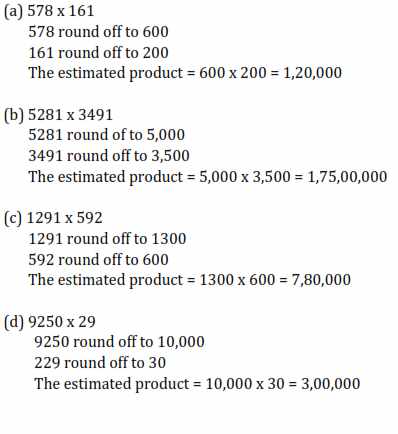
Estimate the following products using general rule:
(a)578 x 161
(b)5281 x 3491
(c)1291 x 592
(d)9250 x 29


A book exhibition was held for four days in a school. The number of tickets sold at the counter on the first, second, third and final day was respectively 1094, 1812, 2050 and 2751. Find the total number of tickets sold on all the four days.
Number of tickets sold on first day |
= |
1,094 |
Number of tickets sold on second day |
= |
1,812 |
Number of tickets sold on third day |
= |
2,050 |
Number of tickets sold on fourth day |
= + 2,751 |
|
Total tickets sold |
= |
7,707 |
Therefore, 7,707 tickets were sold on all the four days.
Shekhar is a famous cricket player. He has so far scored 6980 runs in test matches. He wishes to complete 10,000 runs. How many more runs does he need?
Runs to achieve |
= |
10,000 |
Runs scored |
= – 6,980 |
|
Runs required |
= |
3,020 |
Therefore, he needs 3,020 more runs.
In an election, the successful candidate registered 5,77,500 votes and his nearest rival secured 3,48,700 votes. By what margin did the successful candidate win the election?
Number of votes secured by successful candidates |
= |
5,77,500 |
Number of votes secured by his nearest rival |
= – 3,48,700 |
|
Margin between them |
= |
2,28,800 |
Therefore, the successful candidate won by a margin of 2,28,800 votes.
Kirti Bookstore sold books worth ₹2,85,891 in the first week of June and books worth ₹4,00,768 in the second week of the month. How much was the sale for the two weeks together? In which week was the sale greater and by how much?
Books sold in first week |
= |
2,85,891 |
Books sold in second week |
= + 4,00,768 |
|
Total books sold |
= |
6,86,659 |
Since, 4,00,768,> 2,85,891 |
|
|
Therefore sale of second week is greater than that of first week.
Books sold in second week |
= |
4,00,768 |
Books sold in first week |
= – 2,85,891 |
|
More books sold in second week |
= |
1,14,877 |
Therefore, 1,14,877 more books were sold in second week.
Find the difference between the greatest and the least number that can be written using the digits 6, 2, 7, 4, 3 each only once.
Greatest |
= |
76432 |
Smallest |
= – 23467 |
|
Difference |
= |
52965 |
Therefore the difference is 52965.
A machine, on an average, manufactures 2,825 screws a day. How many screws did it produce in the month of January 2006?
Number of screws manufactured in one day |
= 2,825 |
Number of days in the month of January (31 days) = 2,825 x 31 = 87,575
Therefore, the machine produced 87,575 screws in the month of January.
A merchant had ₹78,592 with her. She placed an order for purchasing 40 radio sets at ₹1,200 each. How much money will remain with her after the purchase?
Cost of one radio |
= ₹ 1200 |
|
Cost of 40 radios = 1200 x 40 |
= ₹ 48,000 |
|
Now, |
|
|
Total money with merchant |
= |
₹ 78,592 |
Money spent by her |
= – ₹ 48,000 |
|
Money left with her |
= |
₹ 30,592 |
Therefore, ₹ 30,592 will remain with her after the purchase.
A student multiplied 7236 by 65 instead of multiplying by 56. By how much was his answer greater than the correct answer?
Wrong answer = 7236 x 65 |
Correct answer = 7236 x 56 |
7236 |
7236 |
x 65 |
x 56 |
36180 |
43416 |
43416 x |
36180 x |
470340 |
405216 |
Difference in answers = 470340 – 405216 = 65,124
To stitch a shirt 2 m 15 cm cloth is needed. Out of 40 m cloth, how many shirts can be stitched and how much cloth will remain?
Cloth required to stitch one shirt |
= 2 m 15 cm |
||
|
|
= 2 x 100 cm + 15 cm |
|
|
|
= 215 cm |
|
Length of cloth = 40 m = 40 x 100 cm = 4000 cm |
|||
Number of shirts can be stitched |
= 4000 ÷ 215 |
||
|
|
18 |
|
215 |
|
4000 |
|
|
− |
215 |
|
1850 |
|
||
|
−1720 |
||
|
|
130 |
|
Therefore, 18 shirts can be stitched and 130 cm (1 m 30 cm) cloth will remain.
Medicine is packed in boxes, each weighing 4 kg 500 g. How many such boxes can be loaded in a can which cannot carry beyond 800 kg?
The weight of one box = 4 kg 500 g = 4 x 1000 g + 500 g = 4500 g Maximum load can be loaded in van = 800 kg = 800 x 1000 g = 800000 g Number of boxes = 800000 ÷ 4500
4500 |
177 |
800000 |
− 4500 35000 −31500 35000
−31500
3500
Therefore, 177 boxes can be loaded.
The distance between the school and the house of a student’s house is 1 km 875 m. Every day she walks both ways. Find the total distance covered by her in six days.
Distance between school and home Distance between home and school Total distance covered in one day
Distance covered in six days
=1.875 km
=+ 1.875 km
=3.750 km
=3.750 x 6 = 22.500 km
Therefore, 22 km 500 m distance covered in six days.
A vessel has 4 litres and 500 ml of curd. In how many glasses each of 25 ml capacity, can it be filled?
Capacity of curd in a vessel = 4 litres 500 ml = 4 x 1000 ml + 500 ml = 4500 ml Capacity of one glass = 25 ml
Number of glasses can be filled = 4500 ÷ 25
180
25 4500
−25
200
−200
0
Therefore, 180 glasses can be filled by curd.




























































































































































































































































































































Just surf through out the webpage of Ideal Coaching. Its a free access to all the Classes 6th, 7th, 8th, 9th,10th,11th and 12th.
Solutions of NCERT Syllabus for Mathematics, Science and Social Science ( Including History, Geography and Polity.) are available absolutely FREE here. And the basic freedom with a click on answer button is really responsive and user friendly
Infact online assistance & guidance is also provided. Just fill the form in contact page to avail the personal guidance from Ideal Coaching absolutely FREE.